Quick Bites: Legal Penalties & Fines
- Driving without valid motor insurance attracts an immediate penalty of ₹2,000 for the first offense under Section 196 of the Motor Vehicles Act.
- A repeated offense can lead to a massive ₹4,000 fine and potential imprisonment for up to 3 months.
- Traffic police instantly track your insurance validity via the Vahan portal during routine checks.
Quick Bites: Financial Hacks
- Always opt for a zero-depreciation cover to ensure 100% claim settlement without out-of-pocket expenses for plastic or metal parts.
- Use premium credit card offers during your motor insurance renewal to grab exclusive cashbacks and reward points.
- Maintaining a high CIBIL score unlocks the lowest premium brackets and better vehicle finance options.
Quick Bites: RTO Process & Fees
- Third-party liability insurance is a non-negotiable legal mandate for all vehicles operating on Indian roads.
- When transferring vehicle ownership via Form 29 and 30, the insurance policy must be transferred within 14 days.
- Failing to update hypothecation details after closing an auto loan will block future insurance claims.
The Hidden Reality of Motor Insurance in India
Imagine driving down a beautifully lit highway, enjoying the ride, when a sudden traffic police interceptor flags you down. You reach for your documents, feeling confident, only to realize your motor insurance expired three days ago. In an instant, your digital profile triggers a massive ₹2,000 traffic challan. This is the harsh reality for millions of vehicle owners across India who fail to understand the strict Regional Transport Office (RTO) guidelines. Motor insurance in India is not just a financial safety net; it is a rigid legal obligation enforced by the Motor Vehicles Act, 1988. Understanding the nuances of these laws is the difference between seamless driving and severe financial disaster. From navigating complex third-party liability claims to leveraging premium credit card offers for your motor insurance renewal, this definitive guide covers every single blueprint you need.
The digitization of transport data has made enforcement ruthless. Handheld terminals used by officers connect directly to national servers. There is no escaping the electronic eye once your vehicle crosses an automated scanning checkpoint. Therefore, maintaining proactive compliance is the only viable path for modern Indian motorists who want to guard their financial assets.
Understanding the Motor Vehicles Act, 1988
The foundation of all traffic regulations in India is built upon the Motor Vehicles Act. Section 146 of this act explicitly prohibits any individual from using a motor vehicle in a public place without a valid insurance policy. This mandate was designed to protect victims of road accidents. If your vehicle causes damage to another person’s property, or results in injury or death, the financial compensation can run into millions of rupees. Without proper insurance, the RTO and the legal system will hold you personally liable, which can result in the liquidation of your personal assets to pay the tribunal awards. To avoid these catastrophic scenarios, you must understand exactly how to secure yourself legally. For a complete breakdown of traffic penalties, you should review our comprehensive guide on Indian traffic fines and e-challans.
The law leaves no room for gray areas or personal excuses. Whether your vehicle is parked in a communal lot or actively cruising a multi-lane expressway, its liability shield must remain unbroken. The statutory framework treats an lapsed policy with the same gravity as operating an unregistered chassis, putting the vehicle owner under constant legal scrutiny.
Furthermore, recent amendments have integrated municipal surveillance feeds with the central database. This means a vehicle with an expired cover can be automatically flagged by city cameras even if you are not stopped physically by a patrol officer. The resulting fine notice is dispatched straight to your registered mobile device, establishing an unavoidable record of non-compliance.
Third-Party Liability vs. Comprehensive Coverage
When you purchase or renew a policy, you are generally presented with two primary categories. The first is Third-Party Liability insurance. This is the absolute minimum requirement mandated by the Indian RTO. Third-party insurance solely covers the damages your vehicle causes to another person, vehicle, or property. It offers absolutely zero financial protection for the damages sustained by your own vehicle. On the other hand, Comprehensive Coverage provides an umbrella of financial security. It covers third-party liabilities while also compensating you for damages to your own vehicle due to accidents, theft, natural disasters, or fire. If you have utilized any vehicle finance options, your lending bank will strictly demand that you maintain a comprehensive policy until the loan is fully paid off. Driving with only third-party insurance might seem cheaper initially, but one minor accident can wipe out your savings. Learn more about the severe consequences by reading our guide on the fines and penalties for driving without valid insurance.
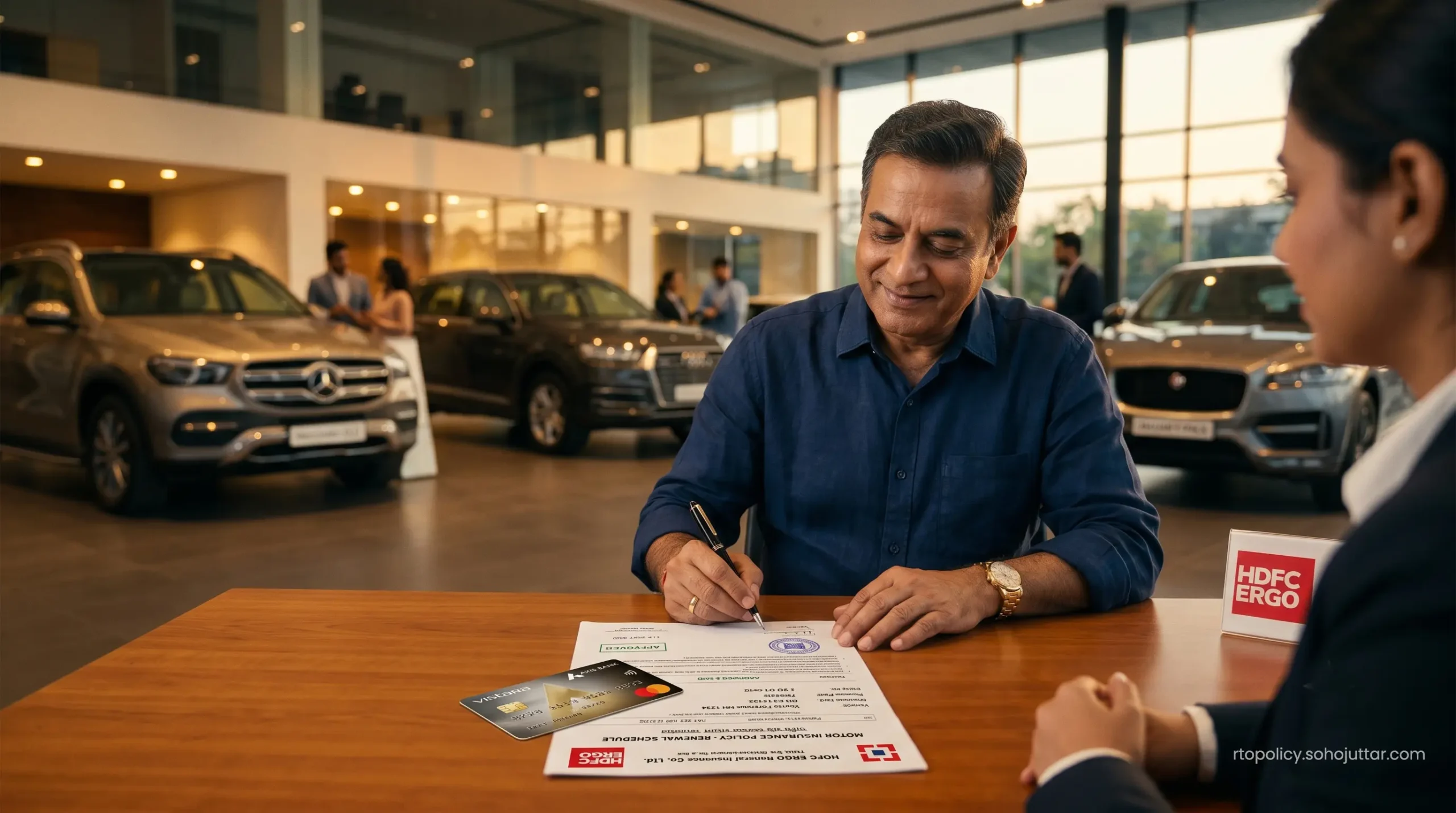
Choosing between these two models requires a deep assessment of your asset valuation. While third-party coverage keeps you clear of immediate statutory fines, it leaves your own vehicular capital entirely exposed to road hazards. A single collision could reduce a premium car to scrap value, forcing you to absorb the replacement costs independently.
Conversely, a structured comprehensive policy functions as a robust asset protection vehicle. It ensures that unforeseen environmental incidents or public liabilities do not disrupt your personal balance sheet. For financed assets, this protection is non-negotiable, acting as a structural guarantee for the underwriting financial institution.
The Power of Zero-Depreciation Cover
As your vehicle ages, its parts lose value due to wear and tear. This reduction in value is called depreciation. Standard comprehensive policies deduct this depreciation amount before settling your claim. This means if your car’s bumper is damaged, the insurance company might only pay 50% of the replacement cost, leaving you to pay the rest out of pocket. By adding a zero-depreciation cover (often called bumper-to-bumper insurance) to your policy, the insurer waives the depreciation factor completely. You receive the full claim amount for replaced parts. This add-on is slightly more expensive during your motor insurance renewal, but it is an elite financial strategy for owners of premium and luxury vehicles.
Depreciation tables set by the Insurance Regulatory and Development Authority (IRDAI) are incredibly strict. Nylon, rubber, and plastic parts immediately lose 50% of their claimable value the moment the vehicle leaves the showroom. Fiber-glass components face a fixed 30% reduction, while glass parts remain the only components exempt from this aggressive calculation scale.
Without a zero-depreciation rider, a major repair bill can force you to pay tens of thousands of rupees out of your own pocket. For any vehicle under five years old, this specific add-on acts as an essential shield, converting potential variable out-of-pocket liabilities into a predictable, fixed annual premium cost.
💎 Mizanur’s Insurance Hack: Maximizing Renewal Benefits
Never auto-renew your motor insurance without negotiating the Insured Declared Value (IDV). Insurance companies automatically drop your IDV by 10-15% annually to reduce their risk. Manually adjust the slider to keep your IDV at the highest allowable limit. Additionally, always use high-tier credit card offers during payment. Premium credit cards classify insurance payments under specific merchant categories, allowing you to earn up to 5% flat cashback or accelerated reward points that offset the cost of your zero-depreciation cover entirely.
Auto Finance Hypothecation and Insurance
When you secure a two-wheeler loan lowest EMI deal or any auto loan, the financier registers a hypothecation against your vehicle at the local RTO. This hypothecation is clearly printed on your Registration Certificate (RC). During the tenure of your loan, any insurance claim payout for total loss or theft will be directly paid to the financing bank, not to you. The bank holds the primary legal right over the vehicle. Once you pay off your vehicle finance options in full, it is highly critical that you legally remove this hypothecation from your RC book. If you fail to do this, renewing your insurance becomes a legal nightmare. Furthermore, if you sell the vehicle without removing the hypothecation, the insurance cannot be transferred. To understand this intricate RTO process, follow our step-by-step blueprint on the hypothecation addition and removal process.

The administrative link between your insurance policy and the lending bank is established via the standard financial endorsement clause. This legal architecture protects the bank’s capital deployment against total asset destruction. If an incident occurs, the insurer coordinates settlement funds directly with the bank’s clearing desk.
Failing to clear the hypothecation status post-loan closure leaves a residual lien on your digital profile. When the Vahan system detects an un-terminated loan entry during subsequent insurance cycles, it restricts policy modifications, preventing you from updating ownership records or adjusting critical endorsement features freely.
How Your CIBIL Score Influences Insurance
In the evolving landscape of Indian financial services, your CIBIL score is becoming a universal metric for trustworthiness. While primarily used for loan approvals, modern insurers are beginning to factor credit history into premium calculations. A high CIBIL score indicates financial responsibility. Insurers correlate financial responsibility with safe driving habits, offering lower premium quotes and better add-on combinations during your motor insurance renewal. Conversely, a poor credit score can flag you as a high-risk profile. This is why maintaining a clean financial record is just as important as maintaining a clean driving record free of traffic challans.
Statistical models used by underwriting teams show a distinct overlap between credit profiles and risk management behavior. Individuals who manage their debts meticulously tend to display lower frequencies of reckless driving and fewer comprehensive damage claims. This data-driven insight is shifting how personal lines of insurance are priced across major metros.
A pristine credit history can unlock specialized institutional discounts that are never advertised to the general public. By keeping your credit utilization low and settling card balances on time, you quietly optimize your automotive compliance expenses behind the scenes.
Mastering Third-Party Liability Claims
Filing a third-party claim against another driver who hit your vehicle is a notoriously complex legal process in India. It requires filing an FIR at the local police station and moving the case to the Motor Accidents Claims Tribunal (MACT). Because the legal process can take years, most elite vehicle owners prefer to claim damages under their own comprehensive policy to fix their vehicle immediately. They then let their insurance company’s legal team recover the costs from the third party’s insurer. This process is known as subrogation and saves you immense mental stress and legal fees. To successfully navigate the bureaucratic hurdles of an accident, you must follow exact RTO protocols. We have detailed this completely in our guide on the legal rights and settlement process for traffic accident claims.

The jurisdiction of the MACT is highly specialized, focusing strictly on civil financial compensations arising from vehicular impact. The tribunal evaluates earnings capacity, age of the victim, and dependency structures to calculate massive liability awards that an uninsured owner could never hope to pay independently.
By leveraging your own comprehensive insurer’s legal machinery via subrogation, you exit the active litigation ring. Your provider settles your immediate repair costs under your own damage guidelines and takes over the long-term legal battle against the offending motorist in the background.
The Vahan Portal Integration
Gone are the days when you could show a fake printed insurance document to a traffic cop. The Indian government has fully digitized vehicle records through the Vahan portal. When you complete a motor insurance renewal, the insurance company’s servers immediately ping the Vahan database via APIs, updating your vehicle’s status in real-time. Traffic police use handheld devices equipped with Automatic Number Plate Recognition (ANPR) cameras. The moment your license plate is scanned, your insurance status, pending e-challans, and auto finance details are visible. Ensuring your details are correctly synced on the Vahan portal is crucial. If your RC book is lost or damaged, you can request a duplicate online. Check out our ultimate guide to Vahan portal registration and services.
The centralized database links seamlessly with state transport authorities across the country. This means if you clear a policy renewal in Delhi, an officer patrolling a remote checkpoint in Kerala can verify the compliance ledger within seconds. The physical document is now purely secondary to the digital footprint.
If an administrative delay prevents your insurance firm from uploading the policy data to Vahan, you remain legally vulnerable to automated fine generation. Motorists must track this digital sync through the mParivahan mobile platform to guarantee their records show active compliance before driving out.
Transferring Insurance During Vehicle Sale
Selling a used vehicle involves strict RTO paperwork, specifically Form 29 (Notice of transfer of ownership) and Form 30 (Application for intimation and transfer of ownership). However, many sellers make a fatal financial error: they forget to transfer the motor insurance policy to the new buyer. Under Indian law, the insurance policy must be officially transferred within 14 days of the vehicle sale. If the new owner causes a fatal accident and the insurance is still in your name, the Motor Accidents Claims Tribunal can legally hold you responsible for the third-party liability claims. Always secure a written undertaking from the buyer and inform your insurance provider immediately. Keep a scanned copy of the delivery note and the updated RC book to protect your financial assets.
The legal transition of liability requires a formal endorsement from the underwriting office. The policy does not automatically follow the vehicle chassis during an ownership change. Until the buyer submits the updated RC showing their name along with the necessary transfer fee, the structural liabilities remain legally anchored to the original registration profile.
Moreover, during this transition window, any accumulated No Claim Bonus (NCB) remains the personal property of the seller. You can request an NCB retention certificate from your provider, allowing you to apply up to a 50% premium discount toward a new vehicle purchase later.
The Impact of a Suspended Driving License
Your motor insurance policy is a contract bound by strict terms and conditions. One of the most critical conditions is that the person behind the wheel must possess an active, valid driving license at the time of an accident. If the RTO has suspended your driving license due to multiple unpaid e-challans or severe traffic violations, your insurance coverage becomes completely void. The insurer will outright reject any damage claims. Furthermore, allowing an unlicensed friend or minor to drive your vehicle not only results in an immediate rejection of third-party liability claims but also invites criminal charges against the vehicle owner. Always ensure your licensing documentation is flawless. If your license is expiring soon, you can renew it seamlessly by following our online application guide for driving license services.
Underwriting guidelines explicitly state that operating an asset under a suspended credential represents a fundamental breach of contract. In the event of a severe highway accident, the insurance firm’s investigative unit will cross-reference the driver’s license number with the central Sarathi database instantly.
If the system reports a status of suspension or disqualification, all own-damage benefits are permanently forfeited. Additionally, the vehicle owner can face personal recovery suits from the insurer if third-party compensations are paid out under statutory court directives, leading to total financial ruin.
Choosing the Right Add-ons for Maximum Protection
Beyond the zero-depreciation cover, premium vehicle owners must structure their policies with strategic add-ons to prevent high-value financial leaks. Engine Protection Cover is an absolute necessity if you live in areas prone to waterlogging, such as Mumbai or Chennai. Standard policies do not cover hydrostatic lock damage caused by driving through deep water. Return to Invoice (RTI) cover is critical for newly financed vehicles. If your car is stolen or declared a total loss, standard insurance only pays the depreciated IDV. RTI cover ensures the insurer pays you the exact on-road price you paid on day one, including the RTO registration fees and road tax. This ensures your vehicle finance options are closed without you paying from your own pocket.

Another high-value add-on is the Consumables Cover. During major accident repairs, standard comprehensive policies exclude items like engine oil, gear oil, nuts, bolts, and coolants from the final settlement. These minor components can add up to a substantial out-of-pocket expense on luxury sports utility vehicles.
By layering your core policy with a combination of engine protection, return to invoice, and consumables coverage, you create an absolute shield around your capital. This transformation shifts your vehicle policy from a basic statutory compliance slip into an elite risk-insulation asset.
Final Thoughts on Financial Security
Navigating the complex landscape of Indian RTO rules and motor insurance policies requires diligence and strategic financial planning. Ignorance of the Motor Vehicles Act is never an accepted legal defense. By securing the right comprehensive coverage, mastering the Vahan portal, and leveraging your CIBIL score for premium credit card offers, you transform vehicle ownership from a liability into a highly protected asset. Stay compliant, respect the traffic laws, and ensure your motor insurance renewal is processed days before the expiry date to maintain a flawless legal driving record.
Frequently Asked Questions (FAQ)
1. Is third-party liability insurance mandatory for all vehicles in India?
Yes, under Section 146 of the Motor Vehicles Act, 1988, having valid third-party liability insurance is a strict legal requirement. Driving without it invites an immediate e-challan of ₹2,000 for the first offense.
2. Does my CIBIL score affect my motor insurance renewal premium?
While historically only used for vehicle finance options, many modern Indian insurers now analyze your CIBIL score as an indicator of financial responsibility, which can positively influence your premium bracket and add-on approvals.
3. What happens to my insurance if my driving license is suspended by the RTO?
If your driving license is suspended or expired at the time of an accident, your insurance contract is considered void. The insurance company will legally reject all own-damage and third-party liability claims.
